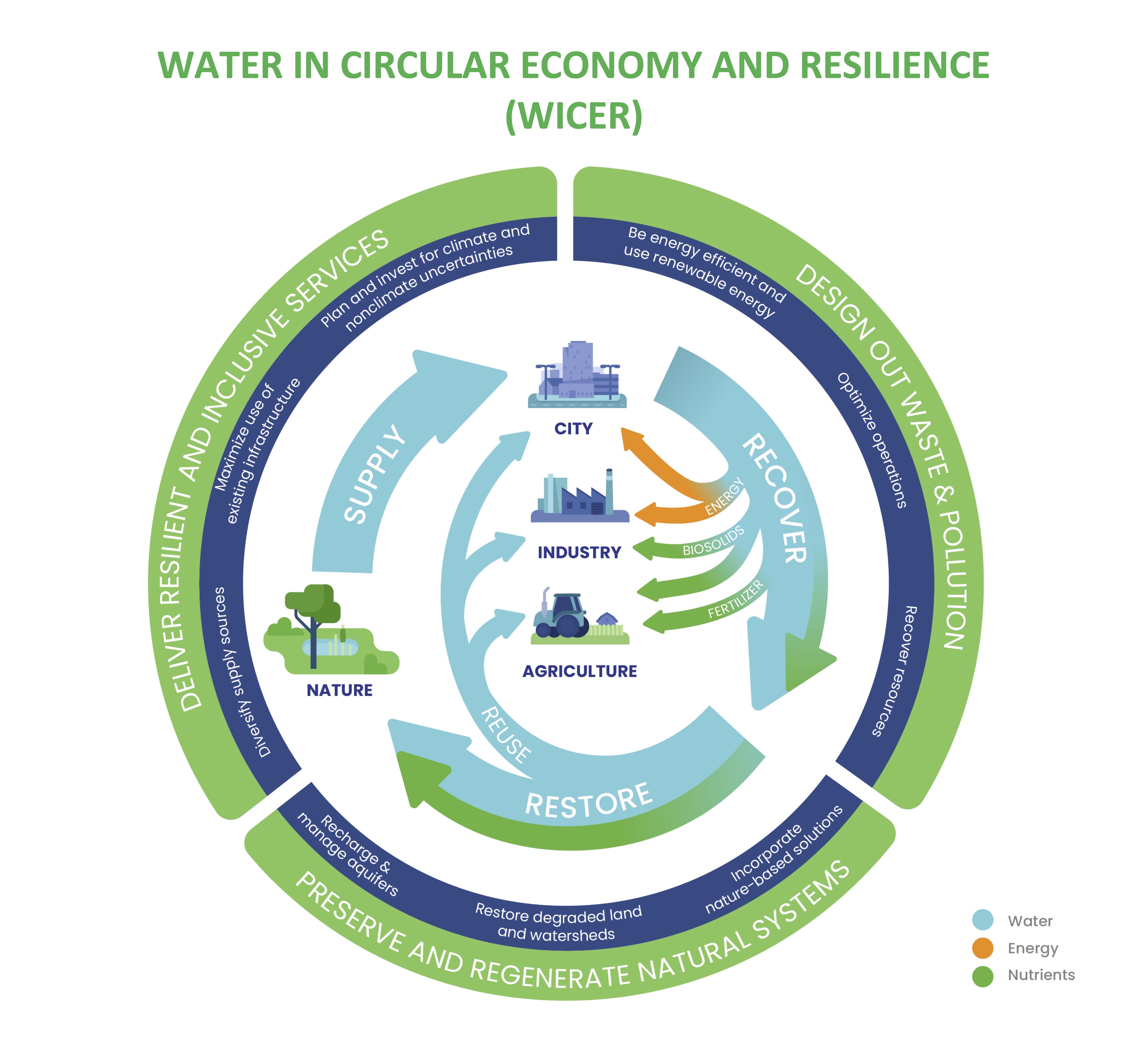
(Source: World Bank Group – Water in Circular Economy and Resilience)
Water often feels like a simple resource that we use every day, from washing cars to grabbing a drink after a workout to flushing the toilet. Water supports many different needs throughout society, so we often think of the various uses for water, like drinking water, wastewater, and storm water, as unrelated and disconnected. In reality, all water is connected and, by treating its various uses as an interconnected cycle, we can create a water system that is stable, resilient to environmental impacts, and protected for generations to come.
The Water in Circular Economy and Resilience (WICER) framework shifts a linear wastewater and water management model toward a circular, interconnected system. The framework focuses on three goals: eliminating pollution, managing water sustainably, and strengthening ecosystem resilience. Storm water is a key part of WICER, providing a dependable resource for aquifer recharge, irrigation, and domestic use with effective management. Green storm water infrastructure can also prevent and reduce pollution, while protecting and restoring native ecosystems. When communities view all water as a part of one cycle, they can get more reuse from the water already in use.
In Hawaiʻi, the WICER framework is being implemented through One Water Honolulu. One Water Honolulu focuses on the connections among all water in Hawai‘i, including drinking water, wastewater, and storm water. The program, which is inspired by the ahupuaʻa system that connected communities and natural resources from mauka to makai, aims to strengthen O‘ahu’s resilience to climate change by developing a water management plan with conservation, replenishment, and reuse goals. Outside of Oʻahu and Honolulu, other islands are also embracing the One Water approach, with Maui allocating 4% of its annual budget to watershed protection and Hawaiʻi Island’s Wai Maoli: Hawai‘i Fresh Water Initiative. Throughout the islands, One Water initiatives continue to support sustainable water across Hawai‘i.
Ingrained within the WICER and One Water frameworks’ is a focus on preventing the pollution of our waterways. One major source of pollution occurs in storm water, when debris, such as single-use plastics, sediment, and oil, are swept into the storm drain system during rain events and eventually reach local waterways and the ocean. Addressing storm water pollution requires a collaborative effort by government agencies, businesses, and the community.
For example, governmental agencies and businesses work together to reduce plastic waste through Extended Producer Responsibility (EPR) laws. EPR laws hold companies accountable for the end-of-life of their products to incentivize them to be more sustainable, often requiring them to pay fees for the waste they generate. Although Hawaiʻi does not currently have any EPR laws in place, a 2025 bill, HB750, requires a study to be conducted by the Department of Health to determine what is needed to establish an EPR program in the state.
The Adopt-A-Highway program is another example of collaboration to reduce pollution. Here on Oʻahu, the Hawaiʻi Department of Transportation partners with local community groups to clean up our roadways and prevent roadway debris from polluting our precious water resources.
Water supports so much life, from mauka to makai, and it is our kuleana (responsibility) to conserve and protect it.
Sources: One Water Honolulu, Extended Producer Responsibility, World Bank