
Welcome to the Hawaiʻi Storm Patrol Young Professionals lesson library. Select a lesson below to access the lesson plan, student worksheets, classroom information sheets, and activities.
Lessons may be completed in sequence as part of the full program or selected individually to complement your classroom curriculum.
INTRODUCTORY LESSON PLANS
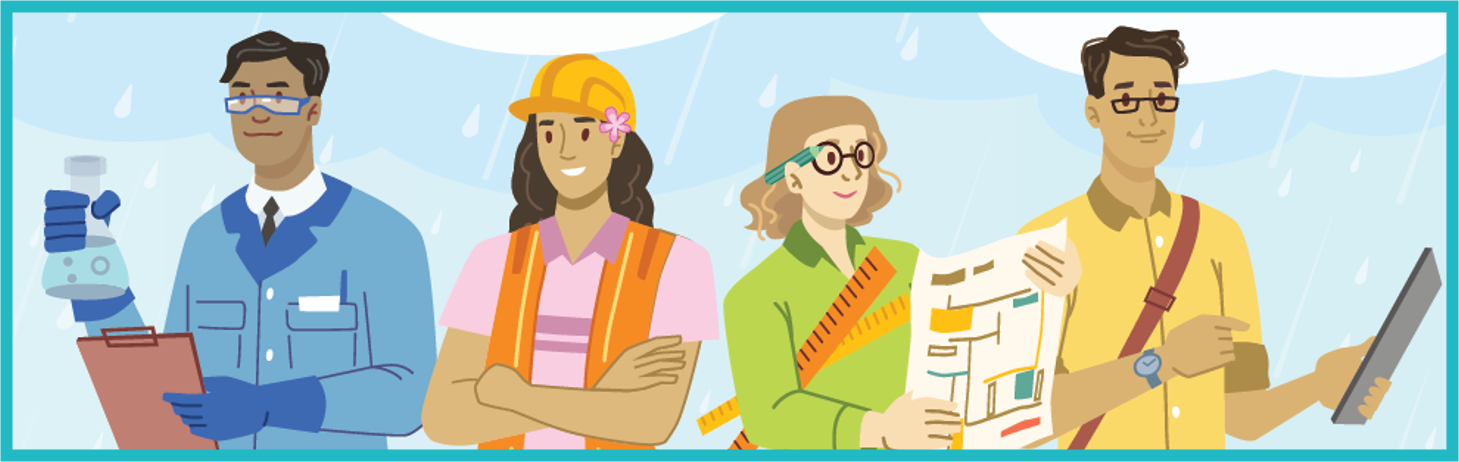
In this initial lesson, students will be introduced to the various water resource careers and learn about preventing pollution to the Maximum Extent Practicable. They will receive Storm Water Career Cards featuring different storm water careers and match them accordingly. they will also learn how water travels through a community.
Place Based Learning Track
Afterschool Track
Conduct Activities I , II, and II, skipping step 9 of Activity III.
Students will learn methods professionals use to reduce the impact of runoff. Using this knowledge, they will explore and notate observations on a site map.
Place Based Learning Track
Afterschool Track
Conduct Activity I and, if plausible, use the SWPPP Site Assessment worksheet to audit your program’s site and then lead a discussion based on steps 7 and 8 of Activity II.
ENVIRONMENTAL PLANNER LESSON PLANS
In this lesson, students will learn about watersheds and the ways in which land within a watershed affects storm water runoff.
Afterschool Track
Conduct Activity I and II.
Students explore balancing a pollution budget, drawing parallels between financial management and water quality management. They will learn about tracking pollutant deposits and charges to manage healthy water ecosystems.
Place Based Learning Track
Afterschool Track
Conduct Activity I and II.
ENVIRONMENTAL ENGINEER LESSON PLANS
This lesson explores designing effective drainage structures, focusing on the importance of select design features that impact water flow dynamics. Through hands-on activities, students investigate the relationship between curve design, slope, roughness, and erosion, while applying principles of fluid dynamics to develop and propose a drainage system design that addresses both immediate and long-term storm water management needs.
Place Based Learning Track
Afterschool Track
Conduct Activities I, II, and III.
In this lesson, students will explore the challenges of trash pollution in storm water systems by calculating their site’s waste and examining material persistence. They will also design thrash capture solutions, enhancing their critical thinking and engineering skills while learning to protect local waterways.
Place Based Learning Track
Afterschool Track
Conduct Activity I and II.
ENVIRONMENTAL SCIENTIST LESSON PLANS
In this lesson, students will learn about designing a storm water monitoring plan. They will explore the steps necessary to create a robust sampling design, discuss methods to ensure that the data collected is accurate and reliable, and perform sampling data analysis.
Place Based Learning Track
Afterschool Track
Conduct Activities I, II, and III.
In this lesson, students will explore how to calculate flow, test or simulate water quality parameters, and integrate their new knowledge into improved monitoring designs.
Place Based Learning Track
Afterschool Track
Conduct Activities I, II, and III.
ENVIRONMENTAL ARCHITECT LESSON PLANS
In this lesson, students will learn about designing storm water-friendly landscapes, which capture, filter, and infiltrate storm water using landscaping and engineering approaches. They will explore the different site-specific factors that influence landscape design plans and the role of landscape architects in creating functional outdoor spaces.
Place Based Learning Track
Afterschool Track
Conduct Activities I, II, and III.
In this lesson, students collaborate to design Green Storm Water Infrastructure based on community engagement.
Place Based Learning Track
Afterschool Track
Conduct Activities I, II, and III.
PROJECT MANAGEMENT LESSON PLANS
In this lesson, students will learn the fundamentals of project management in storm water management, focusing on defining project scope, establishing objectives, and fostering collaboration. Through interactive activities, they will experience the differences between micro-management and collaborative approaches, reinforcing essential skills for effective project execution.
Place Based Learning Track
Afterschool Track
Conduct Activity I and II.
Through interactive activities, promoting teamwork and critical thinking, students will learn the five key steps in project management: Initiation, Planning, Execution, Monitoring, and Closing.
Place Based Learning Track
Afterschool Track
Conduct Activities I, II, and III.
In this lesson, students develop their critical thinking and collaboration skills, emphasizing the importance of tool selection, resource allocation, risk assessment, and community engagement.
Mock Site Track
Place Based Learning Track
Afterschool Track
Conduct Activity I and II.
In this lesson, students will learn about debriefing as a tool for project management and use debriefing skills to reflect on their learning throughout the Storm Patrol Young Professionals Program. Students that worked on projects will present their final project proposals and debrief with their team.
Place Based Learning Track
- All Storm Patrol teams present their Capstone Presentations, following Section 8 of the Storm Patrol Project Workbook
Afterschool Track
Conduct Activity I.
EXTENSION ACTIVITIES
In this lesson, students will explore how storm water systems function in real-world settings. Students are encouraged to observe storm water Best management Practices (BMPs), then discuss how planning, engineering, science, and architecture work together to protect water quality and manage runoff.
Place Based Learning Track
- Students complete the BMP Scavenger Hunt worksheet
Afterschool Track
Conduct Activity I with an off-site Field Trip Observation or II with an on-site Walk the Neighborhood.